Appearance
FLUX 3 Klein native checkpoint qualification
This report gives contributors the bounded checkpoint evidence for the native Swift/MLX FLUX 3 Klein runtime. All four cases pass execution and visual review. The images are AI-generated outputs from these qualification runs.
Checkpoint and runtime
The managed model image-flux3-klein loads the original distilled BF16 package without conversion or a Python inference process. The source is black-forest-labs/flux-3-image-klein at revision 8454017f9ebaada30c998fccd9f67a80c7580f68. The implementation follows BFL's reference at 45e57c9fb06f9751cdced29a65c5d2171003be05.
All four weight files match their pinned SHA-256 hashes. The transformer has 359 BF16 tensors; the autoencoder has 251 tensors and matches the upstream schema. The text encoder uses the original Qwen3-VL-4B shards. The JSON receipt records the weight hashes, inference-source hashes, prompts, input order, output hashes, and process measurements.
The runs use an Apple M3 Max with 36 GiB unified memory and macOS 26.6.2. Normal shared admission remains enabled. Components load and release in stages: text encoder, optional reference autoencoder, transformer, and output autoencoder. Every case uses 16 steps, CFG 1, and seed 42.
Results
Generation seconds come from durable-run timestamps at one-second resolution and exclude admission waiting. The receipt also preserves raw process wall time, which includes queue delays. These shared-host runs are not isolated throughput benchmarks. Peak footprint is the operating system's process measurement, not an MLX allocation counter or a minimum supported RAM claim.
| Case | Canvas | References | Generation seconds | Peak process footprint (GiB) |
|---|---|---|---|---|
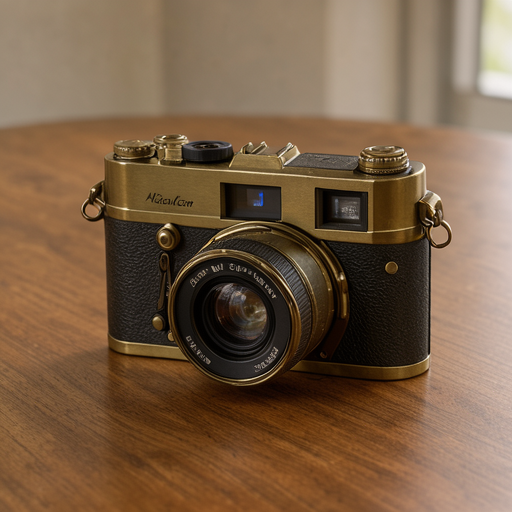
| camera-512-s42 | 512 × 512 | 0 | 47 | 12.69 |
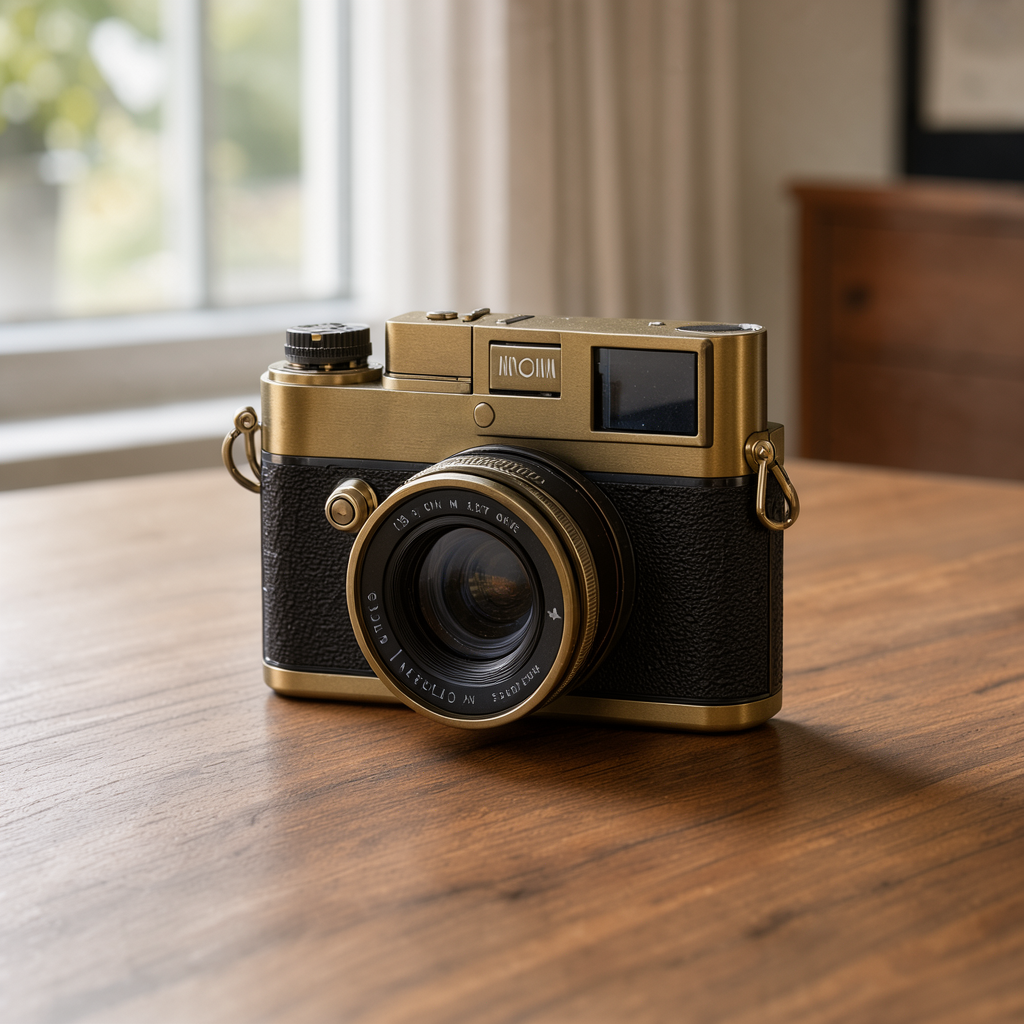
| camera-1024-s42 | 1024 × 1024 | 0 | 116 | 26.77 |
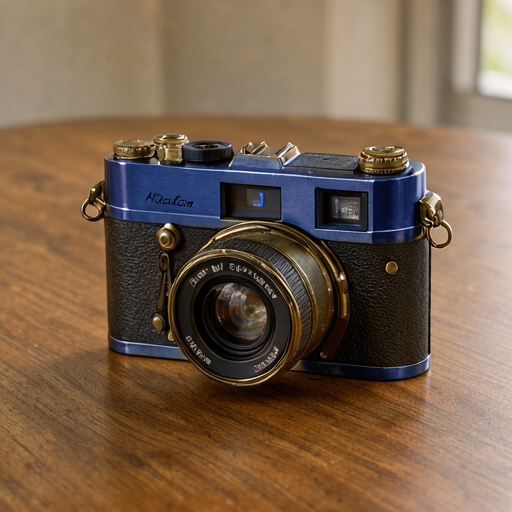
| blue-camera-edit-512-s42 | 512 × 512 | 1 | 65 | 12.81 |
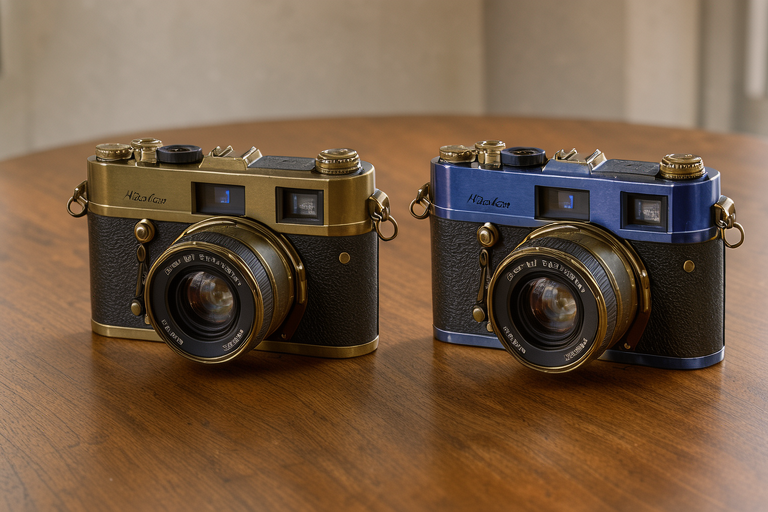
| two-camera-edit-768x512-s42 | 768 × 512 | 2 | 100 | 19.40 |
Text-to-image
Both sizes produce a coherent brass camera on a walnut table with soft window lighting. The 1024 case preserves detail without visible corruption. Seed 42 produces different compositions at different sizes. Small markings contain invented or malformed text; these cases do not qualify typography accuracy.
Single-reference edit
The 512-pixel brass camera is supplied with --input. The prompt changes the metal body to cobalt blue while retaining the camera, black grip, lens, pose, table, and lighting. The output passes the visual checks recorded in the receipt.
Two-reference composition
Two ordered --ref-image arguments supply the brass original and the blue edit. The prompt requests the brass camera on the left and the blue camera on the right. The output passes the composition and color checks recorded in the receipt. This exercises the multi-reference preprocessing and reference-coordinate path.
Reproduce the cases
Obtain gated checkpoint access, configure your Hugging Face token, and review the FLUX Kommunity License before acknowledging it during installation:
bash
mere.run model pull image-flux3-klein --accept-model-license
mere.run image generate --model image-flux3-klein \
  --prompt "A photograph of a brass camera on a walnut table, soft window light, clear realistic materials." \
  --width 512 --height 512 --steps 16 --cfg 1 --seed 42 --output camera-512-s42.png
Repeat with --width 1024 --height 1024 for the larger case. For the single edit, use --input camera-512-s42.png with the exact edit prompt in the JSON receipt. For the composition, pass --ref-image camera-512-s42.png followed by --ref-image blue-camera-edit-512-s42.png, and use a 768 × 512 canvas. Add --run-dir with a different empty directory for each case to retain settings, inputs, output hashes, and completion state.
Validation boundary
Small independent Float32 and BF16 fixtures compare transformer behavior, reference coordinates, flow-map times, and an Euler trajectory against the pinned upstream source. Tiny VAE fixtures compare encoding, decoding, and PNG channel order. Catalog, capability, install validation, input ordering, limits, and scheduler tests cover the public workflow.
These four generated images qualify only bounded execution and visible prompt adherence. They do not establish broad image quality, full-checkpoint numerical parity with BFL, text-rendering accuracy, 4K operation, or ten-reference capacity. The single seed and related camera images are not an independent quality corpus. Native seeds are reproducible within this runtime and do not reproduce PyTorch's RNG. Hardware execution on macOS 15, Linux/CUDA, and iOS remains unqualified by these Mac runs. Hosted CI and application distribution are separate gates.