Appearance
MiniMax-H3-Image M5 affine Q8 acceleration
This follow-up qualifies native packed Q8 computation on an Apple M5 Max with 40 GPU cores and 128 GiB of unified memory. The fastest observed warm 4K request took 229.53 seconds, at a 26.11 GiB session peak. The earlier Q8 report records the fallback baseline. Both use the same 52.04 GB Q8 export, camera prompt, seed 42, 4096 × 4096 canvas, six PDD evaluations, and CFG 1. The original checkpoint remains separate.
Dispatch regression and repair
The pinned MLX fork restricts quantized NAX matrix acceleration to GPU architecture generation 18 or later. This M5 Max reports applegpu_g17s. Floating-point matmul and attention already use NAX, while packed Q8 falls back to slower kernels.
The historical wide-output failure does not reproduce with the current kernel sources on this machine when acceleration is enabled. The repair therefore restores dispatch for affine 8-bit weights only on generation 17 when MLX reports NAX availability. It leaves other quantization modes, alignment checks, and TF32 policy unchanged. No shader bodies or vendored artifacts change. This qualifies a scoped dispatch restoration, rather than a new matrix kernel or a claim that every historical quantization bug is fixed.
The patch binds to MLX Swift 1e077ba968b291e0237d1ab522b271d433fa1713 and embedded MLX e3214809fa5ebd5aac5d6783e8101513b3d9a774. Source preparation checks both revisions and exact original, patch, and resulting host-file hashes. The metallib verifier accepts this exact host change and continues to reject extra tracked dependency edits, including shader edits.
Additional native changes
A synthetic BF16 attention sweep at a representative 4K sequence length of 16,528 rows favored 28-head batches with 1024 queries. Its warm median was 275 ms, compared with 299 ms for 56 heads and 640 queries and 427 ms for eight heads and 640 queries. These are single-layer probes. Every query still attends to every key; this changes scheduling without introducing sparse attention. The native Q8 runtime selects this default on applegpu_g17s. Other architecture and precision defaults retain the previous schedule. Benchmark flags can override both limits.
The VAE decoder now batches up to 32 existing overlapping tiles. It preserves the released FP32 weights, tile geometry, overlap, and assembly order. The encoder keeps sequential tiling. Independent decoder fixtures compare batches of 1, 2, 3, and 32, including two input samples and a partial final batch. Floating-point reordering can change pixels; visual qualification remains necessary.
Measurement boundaries
Release timings include all six denoising evaluations, decoding, and PNG encoding and writing. The first request also loads components and computes conditioning. Later requests retain the transformer and VAE and reuse the identical text conditioning. A different prompt needs conditioner execution and is not timed here. OS peak process footprint covers the whole session; it is not a per-request MLX counter or a minimum RAM requirement.
The host runs macOS 27.2 on AC power, with other desktop applications open. Image jobs run sequentially. File caches are not purged. The initial NAX-only pair overlapped repository compilation; the final configuration runs after the validation gate finishes. This is one prompt and seed, not a throughput distribution or general quality benchmark.
Results
| Native 4096 × 4096 configuration | First request (s) | Warm request (s) | Peak process footprint (GiB) |
|---|---|---|---|
| Original BF16 baseline | 498.93 | — | 72.12 |
| Packed Q8, generation-17 fallback | 510.76 | — | 26.16 |
| Q8 storage, resident BF16 compute | 289.17 | 246.51 | 43.47 |
| Restored Q8 NAX, 56 heads, 640 queries, sequential decode | 298.52 | 229.53 | 26.11 |
| Restored Q8 NAX, 28 heads, 1024 queries, 32 decode tiles per batch | 272.55 | 241.91 | 26.31 |
The first two historical rows are single CLI runs that include admission. The resident BF16 and NAX-only rows each have one warm repeat. The last row reports the median of two warm repeats, 239.60 and 244.23 seconds. Its first request took 47% less time than the old packed fallback run, at similar peak memory. The fastest observed warm request is 229.53 seconds, about 3.28 times the 70-second target.
The restored Q8 kernel measured 23.18 ms for a synthetic BF16-input projection with shape M=4096, K=5376, N=28672, down from 91.34 ms with the fallback. Dense BF16 took 20.33 ms with the restored build. These medians exclude the first evaluation and isolate one projection.
| Warm phase (s) | Restored NAX, sequential decode | Restored NAX, tuned attention and batched decode |
|---|---|---|
| QKV preparation | 43.00 | 47.36 |
| Attention | 82.89 | 88.64 |
| Feed-forward and residual work | 91.32 | 97.63 |
| Entire denoising loop | 217.36 | 233.90 |
| All other request work | 12.18 | 8.01 |
The batched configuration spent about four seconds less outside denoising, where VAE decoding and PNG output run. It did not improve warm end-to-end latency in this comparison. Several denoising phases varied together between requests, so the separate sessions do not isolate the effect of attention scheduling. The synthetic attention improvement did not translate into a measured warm gain over the 56-head control.
At a representative 16,528 rows, the four dense block projections and full attention across 50 layers and six steps account for about 6.17 quadrillion arithmetic operations when a multiply-add counts as two. A 70-second budget would require roughly 88 trillion operations per second for that work alone, before the rest of the request. This is a workload estimate. The phase timing points to feed-forward work and full attention as the largest remaining costs. Fused normalization, rotary embedding, and projection epilogues merit separate real-shape tests before another default change.
Image quality
The three PNGs from the 28-head, batched-decode session are byte-identical. Compared with the sequential-decode NAX control, the maximum decoded RGB channel difference is one level out of 255; mean absolute differences are 0.0034, 0.0034, and 0.0034 levels for red, green, and blue. This compares the combined settings on one prompt and seed.
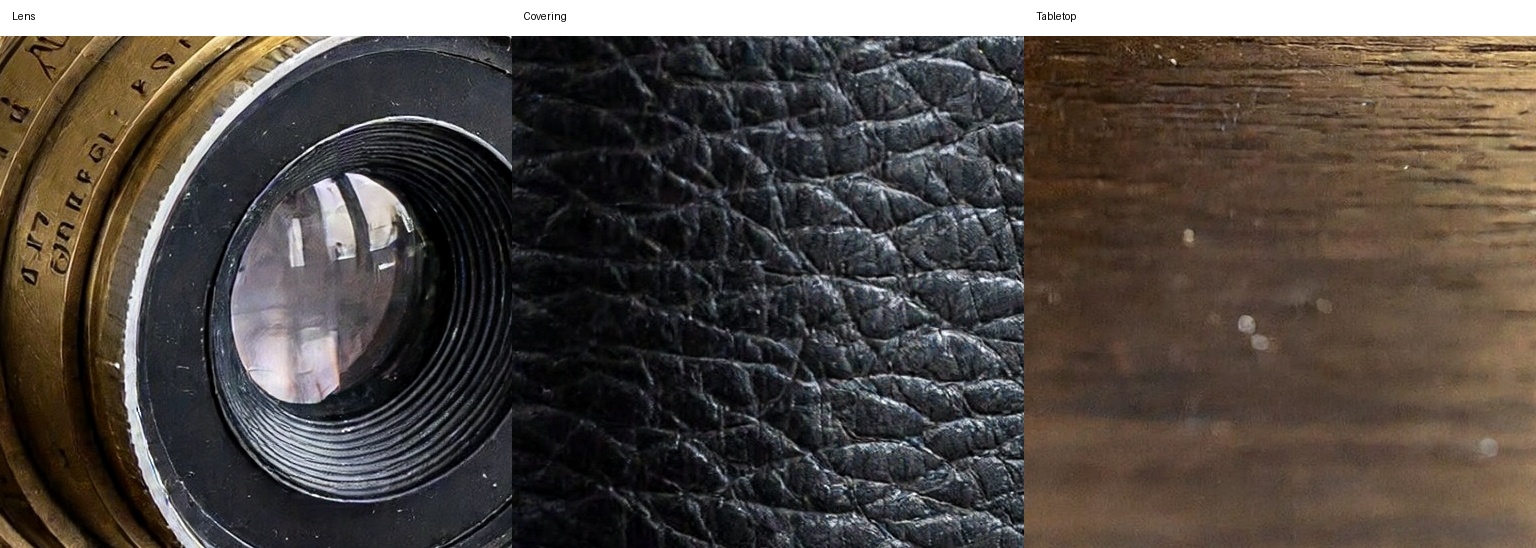
Whole-frame review and unscaled 512-pixel lens, covering, and tabletop crops show coherent geometry and clear material detail, with no obvious tile seams or mosaic corruption. The cup is larger than requested and the camera still has malformed fine markings. Editing, other prompts, and other devices remain outside this qualification.

Upstream comparison
The SGLang recipe currently reports 84.96 seconds at 4736 × 3552 on one DGX Spark GB10. It uses native precision, resident components, exact AdaLN precomputation, and warm conditioning. Its median covers 10 warm requests across two fresh servers and excludes startup, HTTP, PNG encoding, and saving. Hardware, aspect ratio, precision, and timing boundaries differ from this native MLX measurement. This report uses 70 seconds as a stretch goal for the M5 Max.
Reproduction
bash
python3 scripts/prepare_mlx.py
swift build -c release --product mere.run
release_dir="$(swift build -c release --show-bin-path)"
"$release_dir/mere.run" model benchmark h3-image --model-root ./image-minimax-h3-q8 \
  --prompt "$PROMPT" --size 4096 --runs 3 \
  --attention-heads 28 --attention-queries 1024 --vae-tile-batch 32 \
  --output ./h3-m5-q8-benchmark --json
Use the same prompt recorded in the JSON receipt. Set MERERUN_H3_IMAGE_PROFILE=1 for phase timings on stderr and wrap the process with /usr/bin/time -l for whole-session peak memory. The contributor benchmark emits benchmark.json and each PNG's SHA-256. It uses packed Q8 unless --resident-bf16 is passed. For the NAX control settings, use --attention-heads 56 --attention-queries 640 --vae-tile-batch 1.
Validation
The repository gate passed. Nine affine Q8 regression tests passed on Metal with TF32 disabled and again with TF32 enabled. Seven image computation tests and five Q8 packing and loading tests passed on Metal with TF32 disabled. The shader verifier confirmed that the release used the unchanged vendored metallib. The JSON receipt retains model, binary, source, host patch, shader, and output identities and per-request timings.