Appearance
MiniMax-H3-Image native Q8 qualification
This report records the original generation-17 fallback measurements. The M5 Q8 acceleration follow-up restores scoped Q8 acceleration and qualifies subsequent attention and decode changes.
Native Swift/MLX Q8 export combines affine 8-bit/group-64 linear weights with an exact six-step AdaLN cache. The original checkpoint remains separate. Measurements use the same Apple M5 Max with 40 GPU cores, 128 GiB of unified memory, macOS 27.2, AC power, camera prompt, and seed 42 as the original BF16 qualification. Every image uses all six released PDD evaluations at CFG 1.
Checkpoint
The source is MiniMax-H3-Image at the pinned revision. The exported checkpoint occupies 52,035,131,360 bytes, or 52.04 GB / 48.46 GiB, compared with roughly 135.38 GB for the selected original files. This reduction combines three changes; it is not a measurement of quantization alone:
- Quantize eligible BF16 linear weights to MLX affine Q8/group 64. Deinterleave original per-head QKV rows before packing. Retain embeddings, FP32 tensors, and vision matrices whose input widths do not align to 64.
- Replace 26.02 GB of timestep-only block AdaLN weights with a 116.51 MB cache containing the original-precision outputs for every released timestep and the fixed reference timestep.
- Omit Qwen decoder layers after the layer-50 activation used for conditioning.
The transformer directory occupies 21.32 GB, the text encoder 28.22 GB, and original FP32 VAE 2.34 GB. The export includes the tokenizer, processor, original license and acknowledgment, source identity, and hashes of 24 weight shards. h3_image_mlx.json distinguishes these native packed keys from raw checkpoint keys. The loader validates all shards and required parameters.
Optimizations from the upstream comparison
The SGLang recipe precomputes AdaLN, prepares rotary tables and text refinement once per request, retains model components, and caches conditioning for repeated inputs. The native Q8 path now supports those operations for text-only benchmarks. Reference conditioning is recomputed for every request.
The comparison also exposed a precision mismatch. Native rotary tables were FP32, which promoted BF16 Q/K attention and the following residual stream to FP32. The pinned reference implementation casts cosine and sine to the activation dtype before multiplication. The image runtime now does the same. FP32 and mixed-BF16 six-step fixtures pass on CPU and Metal after this correction.
Large sequences retain full attention to all keys while bounding projection intermediates to 4096 rows and query batches to 640 rows. Contributor benchmarks can change the number of heads per kernel. They can also expand Q8 transformer weights to resident BF16 one block at a time, testing dense compute against packed Q8 compute. This preserves Q8 storage but uses more runtime memory and rounds the reconstructed weights to BF16; it does not recover original weights.
Measurement boundaries
Release measurements include prompt preparation, all six denoising evaluations, VAE decoding, and PNG encoding and output. The first request loads models and conditioning; later requests reuse the transformer, VAE, and identical text-only conditioning. OS peak process footprint from /usr/bin/time -l covers the whole session. It is not a per-request MLX allocation counter or a minimum RAM claim. File caches are not purged. Measurements use a shared desktop host. The repeated requests use one identical prompt. A new prompt needs conditioner execution while retained components remain, so its latency and memory can be higher; that case is not measured here.
SGLang reports 16.21 seconds at 2048 × 2048 and 84.96 seconds at 4736 × 3552 on one DGX Spark GB10, with native precision, resident components, exact AdaLN precomputation, and warm conditioning. Its median covers 10 warm requests across two fresh servers and excludes startup, HTTP, PNG encoding, and saving. Our square 4096 × 4096 canvas has a similar pixel count but a different aspect ratio, and the hardware and quantization differ. MLX affine Q8 is not CUDA FP8 or MXFP8. These figures cannot establish equal hardware performance or a 70-second Apple Silicon target.
Results
| Output and compute | First request seconds | Warm request seconds | Peak process footprint (GiB) |
|---|---|---|---|
| 2K original BF16 baseline | 212.91 | — | 67.35 |
| 2K packed Q8 | 169.46 | — | 26.11 |
| 2K Q8 stored, resident BF16 compute | 58.05 | 43.99 | 40.93 |
| 4K original BF16 baseline | 498.93 | — | 72.12 |
| 4K packed Q8 | 510.76 | — | 26.16 |
| 4K Q8 stored, resident BF16 compute | 289.17 | 246.51 | 43.47 |
The CLI rows include admission; the retained contributor benchmark measures the generator directly. Each dense row covers one first request and one repeated warm request, rather than a throughput distribution. First-request file reads vary with the OS cache. The 2K CLI run overlapped repository validation, which finished during the 2K dense session. Our image inference runs were sequential. The original BF16 baseline predates the cache and rotary correction, so these are combined-runtime comparisons, not an isolated quantization speedup.
Packed Q8 2K denoising took 125.73 seconds, with the five later steps taking about 18 seconds each. Dense BF16 compute from Q8-stored weights took 41.07 seconds for the first request's denoising loop and 39.32 seconds for the warm request's loop. The two dense 2K PNGs have identical SHA-256 hashes.
Packed Q8 4K denoising took 485.18 seconds, against 424.66 seconds in the original BF16 baseline. Its five later denoising steps averaged 82.11 seconds. The packed path substantially reduces memory here but does not improve 4K wall time. Its five later steps spend 102.92 seconds in QKV preparation, 214.09 seconds in output/feed-forward work, and 93.47 seconds in attention.
With resident BF16 compute and 56-head attention batches, 4K denoising took 229.60 seconds for the first request and 228.88 seconds for the warm request. Both 4K PNGs are byte-identical. The warm request spends 44.47 seconds in QKV preparation, 92.57 seconds in output/feed-forward work, and 91.47 seconds in attention. The remaining gap to the published GB10 pipeline time therefore extends beyond loading and PNG output; denoising remains the dominant cost. This qualification does not reach a 70-second native 4K result on the M5 Max.
The installed MLX fork explains an important part of this result. Its quantized dispatcher permits NAX matrix acceleration only on architecture generation 18 or later, retaining a generation-17 correctness workaround. This M5 Max reports applegpu_g17s. Floating-point matmul and attention retain NAX availability. The qualification keeps the existing restriction; it does not bypass the quantized regression guard. Results apply to the pinned MLX Swift revision 1e077ba968b291e0237d1ab522b271d433fa1713 and embedded MLX revision e3214809fa5ebd5aac5d6783e8101513b3d9a774.
An isolated BF16-input projection at the real feed-forward shape 4096 × 5376 × 28672 measured a warm median of 91.34 ms for packed Q8 and 21.18 ms for dense BF16, excluding the first evaluation in each mode. This 4.3× kernel difference is not an end-to-end speed claim. It explains why lower storage precision alone does not provide the fastest compute path on this M5. A quiet attention probe favored 56-head batches over eight-head batches by about 1.3×; increasing query batches beyond 640 rows did not improve its median. Earlier probes overlapping image inference showed larger, unrepresentative head-batching differences and are excluded from these conclusions.
Visual review
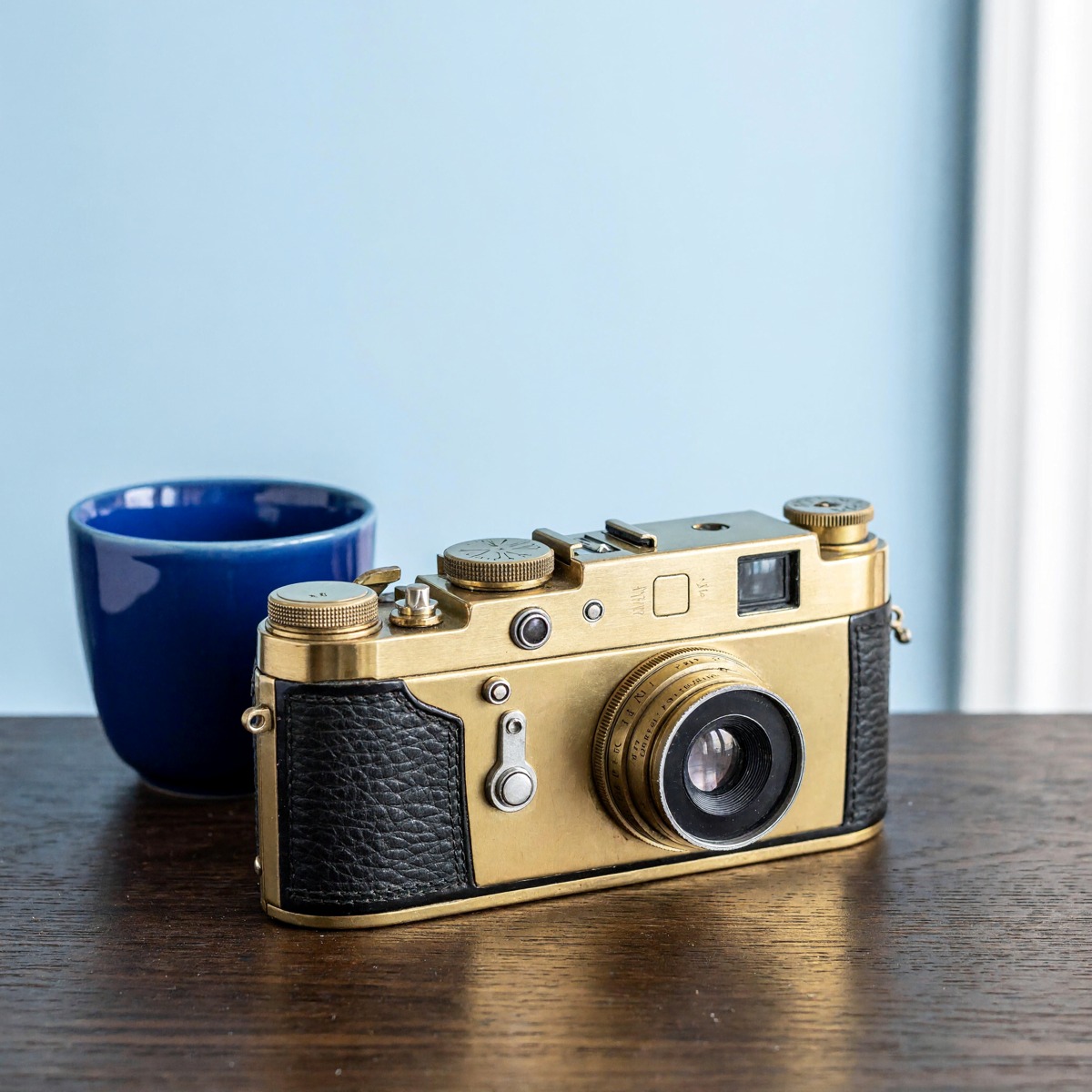
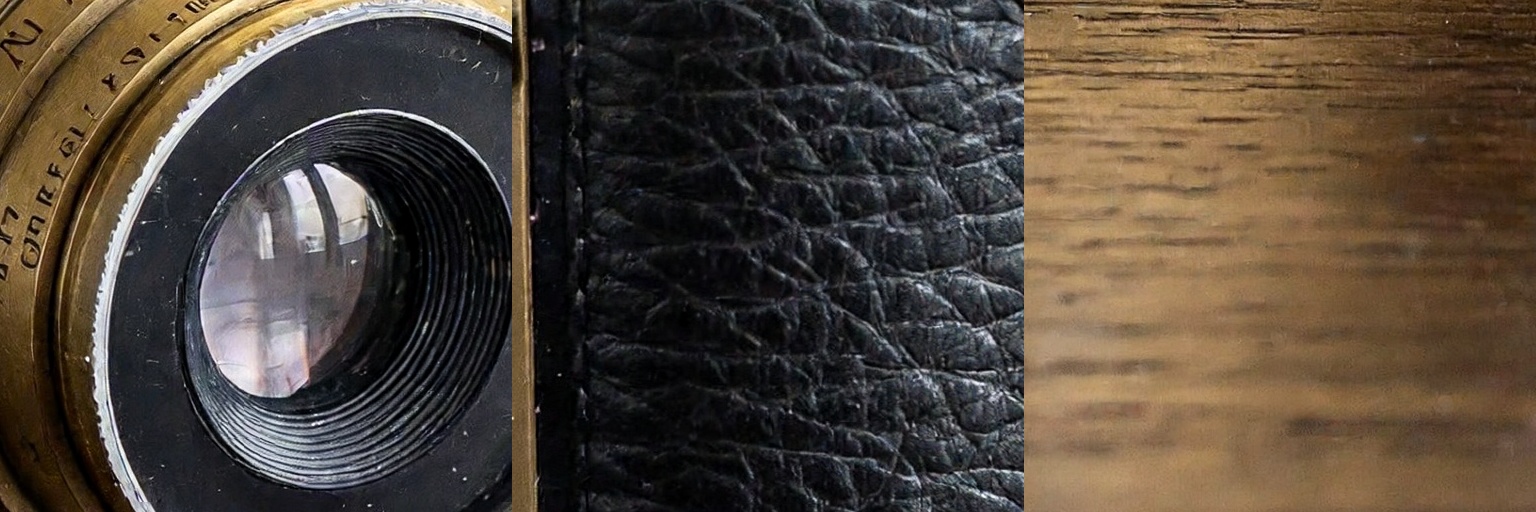
The packed 2K image has a coherent brass rangefinder-style camera, one primary lens, textured black covering, a blue cup behind on the left, and a walnut tabletop. Whole-frame review and unscaled 512-pixel lens, covering, and tabletop crops found no obvious tile seams or mosaic corruption. Dense BF16 compute preserves the composition but changes small controls and invented markings. The oversized cup and malformed engraving remain model limitations.
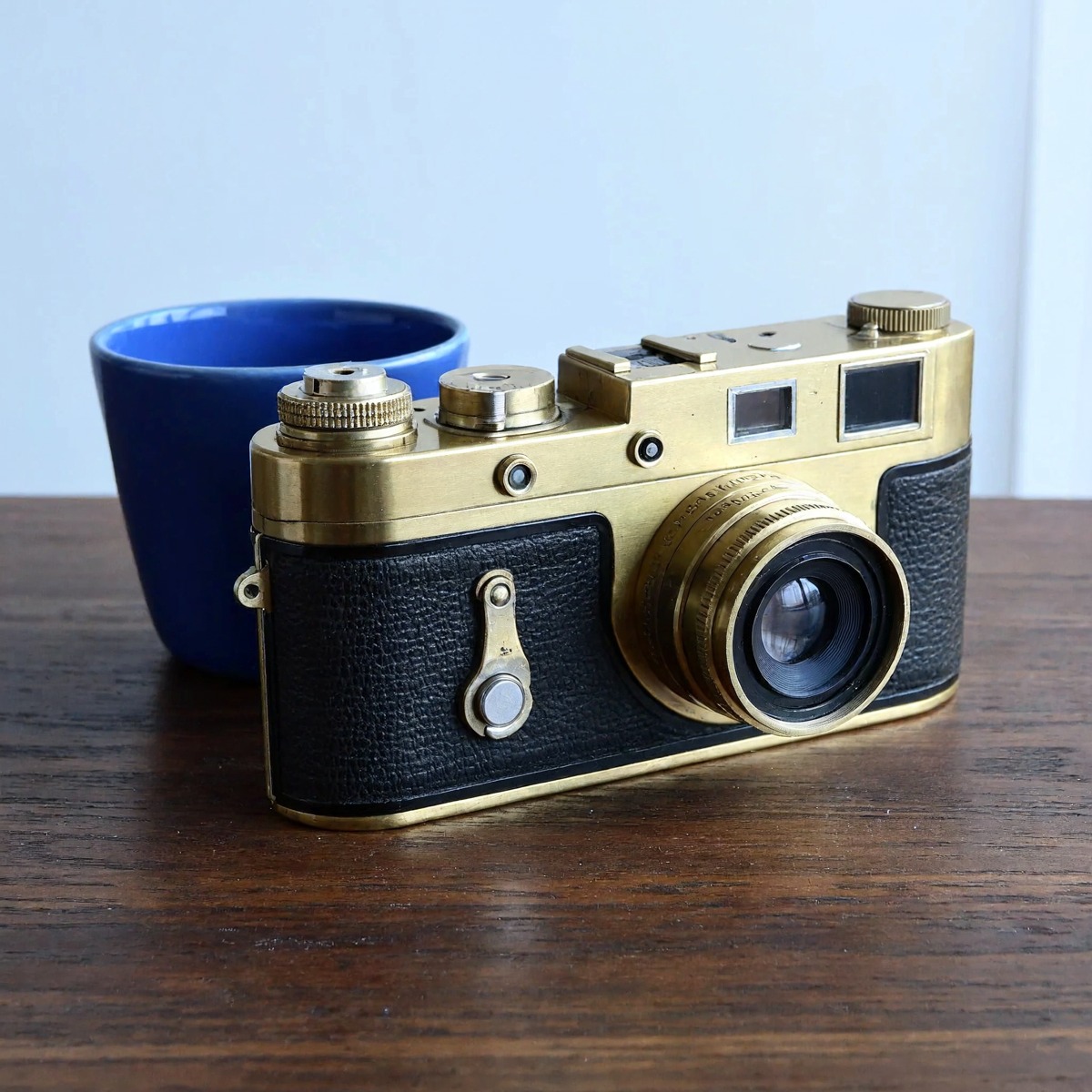
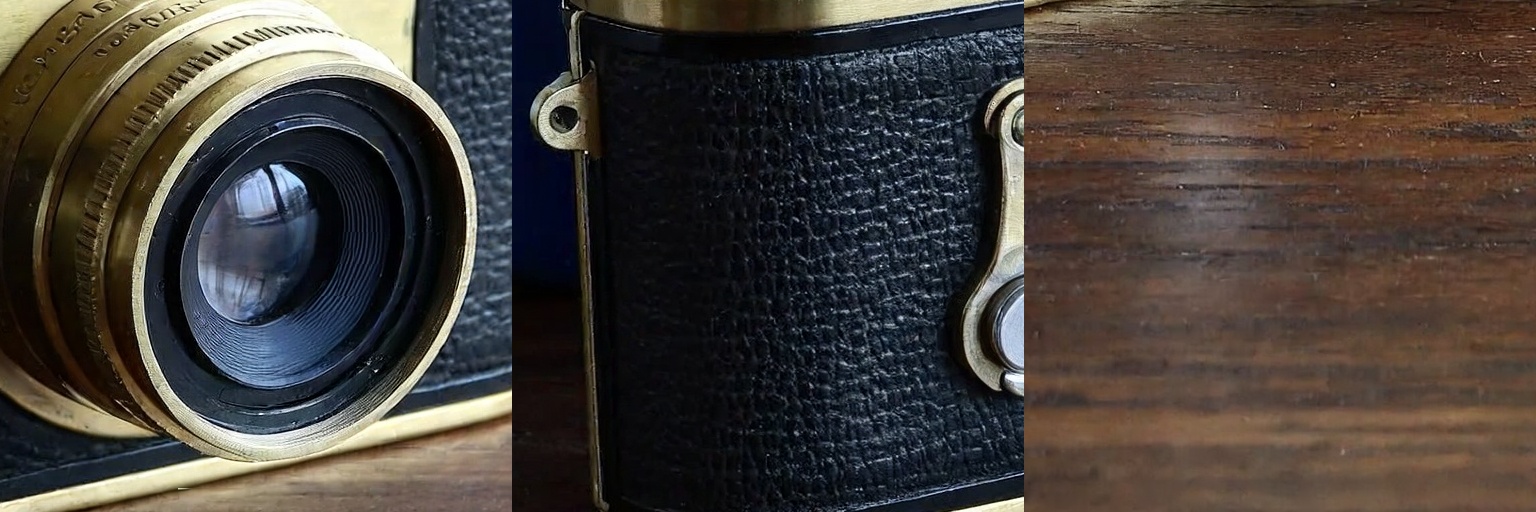
The packed 4K image retains fine lens rings, worn metal, and textured covering. The reviewed frame and unscaled crops have no obvious tile seams or mosaic corruption. Its composition places the subjects lower in a larger field of blue background. Invented markings and the oversized cup remain.
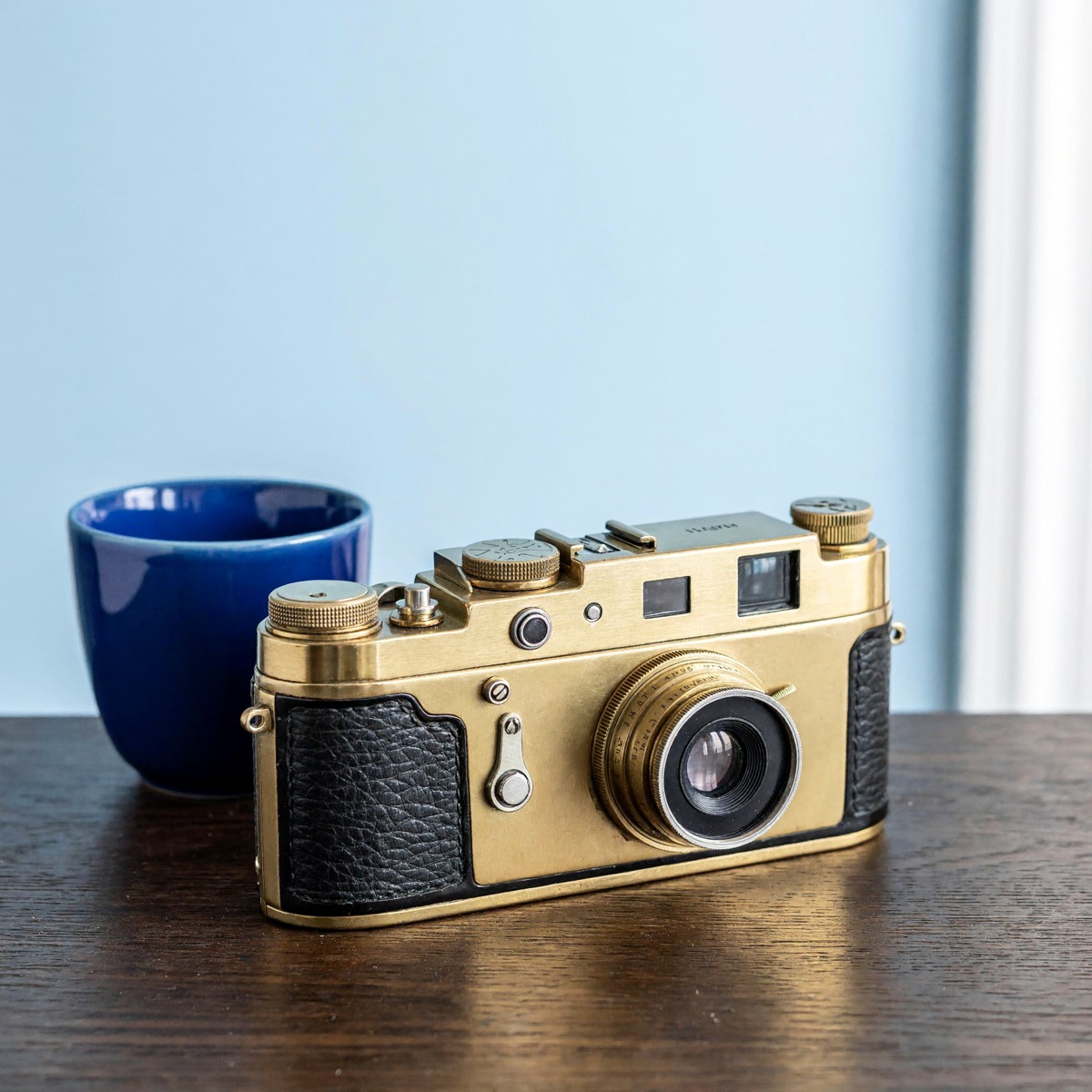
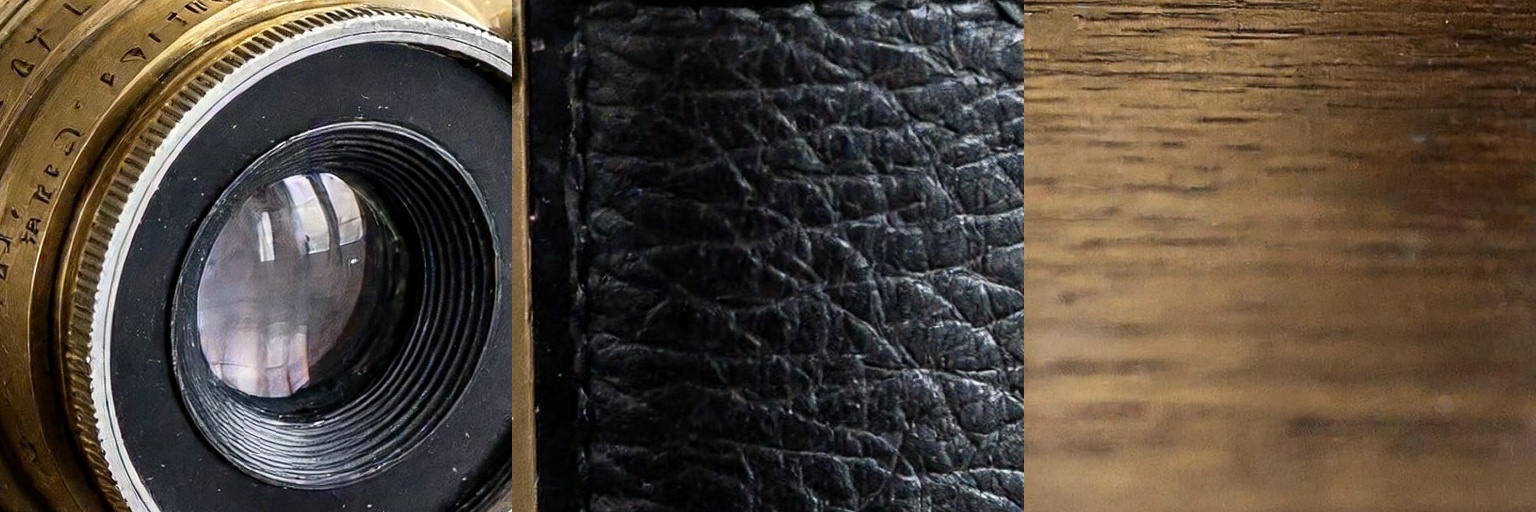
The faster 4K mode retains the same main composition and material detail. Its small controls and lens engraving differ from the packed path. Whole-frame review and unscaled lens, covering, and tabletop crops found no obvious tile seams or mosaic corruption. Equal hashes confirm identical output for the two repeated requests in this session, not general visual equivalence across modes.
Reproduction
After installing and accepting the source checkpoint license:
bash
mere.run model optimize image-minimax-h3 --output ./image-minimax-h3-q8 --json
mere.run model benchmark h3-image --model-root ./image-minimax-h3-q8 \
  --prompt "$PROMPT" --size 4096 --runs 3 \
  --output ./q8-benchmark --json
The exact prompt is retained with the measurement receipt and matches the original BF16 report. Add --resident-bf16 for dense transformer compute and --attention-heads 56 to test the larger attention batch. Set MERERUN_H3_IMAGE_PROFILE=1 for per-block and large-sequence QKV, attention, and feed-forward timings on stderr. Each benchmark run retains its PNG and SHA-256 hash. Use a new output directory for each configuration.
Validation and remaining targets
./scripts/check.sh passed after the final Swift changes. Six image computation fixtures and four Q8 packing/loading tests passed directly on Metal with MLX_ENABLE_TF32=0; the repository gate covers their CPU paths. Generated command documentation includes the new benchmark. The JSON receipt retains binary, source, shader-library, manifest, cache, and output identities, along with phase timings and the standalone probe results. The final 31 guide and documentation-contract tests and pnpm docs:build also passed after the measured results were added.
The first real Q8 loader attempt exposed sparse module-array replacement across shards. Updating a complete leaf-module tree preserves the other layers; a regression loads array layers out of order, and the subsequent real generations use the corrected loader. Failed and interrupted diagnostic runs are excluded from the result table.
The next memory/speed experiment is temporary BF16 expansion of one transformer block at a time, followed by release of its dense copy. The measured projection gap motivates that experiment, but it is not implemented or timed here. It would need comparison against both packed Q8 and resident BF16 for numerical behavior and peak memory. Upstream's fused norm/rotary operations and batched VAE tiles are additional targets. Native decode currently retains the original FP32 VAE and sequential overlapping tiles; changing decoder precision also needs separate quality qualification.
Scope
This qualification covers one text-only prompt and seed at the measured sizes. It does not establish general visual parity, reference editing fidelity, typography accuracy, other seeds or aspect ratios, or support on smaller Macs. Native MLX and PyTorch random streams differ, so equal integer seeds do not produce a matched upstream image for pixel comparison.